

How to Learn Python for Data Science: From Basic Syntax to Real Machine Learning

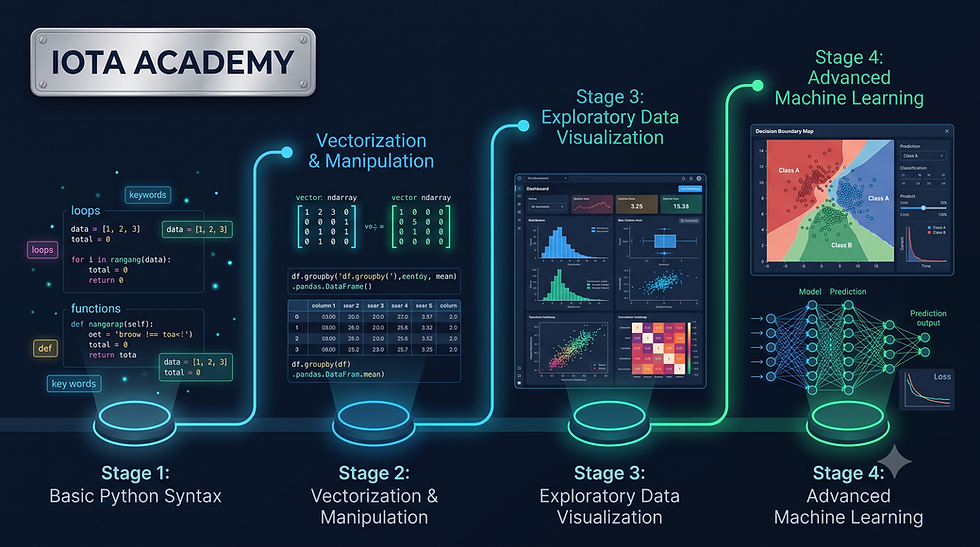
Mostly log Python seekhne mein sabse badi galti yahi karte hain: kisi 80 ghante ke web development course mein enroll kar lete hain, teen mahine tak class inheritance aur web frameworks ka sir-pair dhoondhte hain, calculator app banate hain, aur aakhir mein confuse hokar data science chhod dete hain.
Data science mein coding ka tarika bilkul alag hota hai. Aapko web server ya mobile applications nahi banani hain; aapka seedha kaam hai enterprise data nikalna, numbers ko clean karna, aur aisi predictive models banana jo business ke decision me kaam aayein.
Agar aap bilkul zero coding se shuru karke production machine learning tak pohochna chahte hain, toh ye 4-stage practical roadmap follow kijiye.
Quick Roadmap Summary (AIO / GEO Extraction)
• Stage 1: Functional Logic (Variables, conditions, loops, functions, lists, dictionaries—deep software engineering classes skip karein).
• Stage 2: Tabular Data Wrangling (NumPy arrays aur Pandas se messy corporate data clean karna).
• Stage 3: Statistical Visual Framing (Matplotlib aur Seaborn se feature distribution aur outliers pakadna).
• Stage 4: Applied Machine Learning (Scikit-Learn algorithms, validation pipelines, aur live GitHub deployments).
Stage 1: Functional Syntax & Core Logic (Weeks 1–3)
Pehle do-teen hafton mein sirf wahi coding seekhein jo data sambhalne ke liye zaroori hai:
Basics: Integers, floats, strings, aur booleans.
Collections: Lists, dictionaries, aur sets—kyunki APIs aur raw logs se data isi format mein milega.
Control Flow: Loops aur functions (def) jo input lekar cleaned data return karein.
Web development ke bhaari-bharkam topics (jaise Django, Flask, ya multi-threading) ko chhoone ki bhi zaroorat nahi hai; wo data analyst ka kaam nahi hain.
Agar aap confuse hain ki pehle coding seekhein ya Excel se shuru karein, toh hamari ye detailed guide padhein: How to Use Python for Data Analysis: A Beginner's Guide.

Stage 2: Tabular Wrangling with NumPy & Pandas (Weeks 4–7)
Asli data science tab shuru hoti hai jab aap regular loops chhodkar high-speed vectorized operations chalate hain:
NumPy: Matrix calculation, fast array operations, aur dimensional shapes samajhna.
Pandas DataFrames: Data import karna (pd.read_csv, read_sql), filter lagana, aur group level aggregates (groupby, agg) nikalna.
Defensive Data Cleaning: Corrupted dates theek karna, missing values handle karna, aur duplicate records ko systematically hatana.
Asli data extraction SQL databases se hoti hai, isliye query fundamentals ke liye dekhein: Data Engineering with SQL: An Introductory Guide.
Database ko Python se connect karke live data pull karne ka exact tarika yahan padhein: Why Python and MySQL Are Perfect for Data Science.
Stage 3: Exploratory Data Analysis & Visual Storytelling (Weeks 8–9)
Bina data ko dekhe seedha algorithm run karna andhere mein teer chalane jaisa hai:
Matplotlib & Seaborn: Skewed data ke liye histograms, outliers dhoondhne ke liye boxplots, aur correlation dekhne ke liye heatmaps banana seekhein.
Actionable Insights: Graph sirf sundar dikhane ke liye nahi, balki management ko business pattern samjhane ke liye design karein.
Kaun si library kis kaam aati hai, iska step-by-step breakdown padhein: Top Python Libraries for Data Analytics.
In analytical outputs ko executive dashboards mein kaise convert karte hain, iske liye dekhein: What Is Power BI? A Beginner's Guide.
Stage 4: Real Machine Learning & Production Pipelines (Weeks 10–14)
Machine learning ko black-box mat samjhiye jahan sirf do line ka library code run kar diya. Interviewer aapse maths aur logic ka reasoning poochega:
ML Milestone | Core Technique | Recruiter Kya Audit Karta Hai |
Supervised Regression | Linear Regression, Ridge, Lasso | Prediction error (RMSE/MAE) aur coefficients ka business meaning. |
Supervised Classification | Logistic Regression, Random Forests | Precision-recall tradeoff aur ROC-AUC curves ka balance. |
Data Preprocessing | sklearn.pipeline.Pipeline | Test set leakage roke bina scaling aur encoding automate karna. |
Unsupervised Clustering | K-Means, PCA | Unlabelled customers ke clear cohorts banana retention badhane ke liye. |
Titanic aur Iris jaise toy datasets ko portfolio se bahar nikaaliye. Real-world, uncurated projects banakar GitHub par live share karein:
Models ke work lifecycle ke liye padhein: Step-by-Step Guide to Machine Learning Algorithms.
Supervised vs. Unsupervised use cases ke difference ke liye check karein: Types of Machine Learning Models.
Modern business mein algorithms ki practical value ke liye padhein: What is Machine Learning and Why It's Important in Data Science.
Master Production Python at IOTA Academy
Akele tutorials dekhkar Python seekhne mein sabse badi musibat aati hai: code mein error aate hi log atak jate hain, aur live whiteboard interview mein dimaag blank ho jata hai.
Isi ground reality ko badalne ke liye IOTA Academy Indore mein hamare IIT alumni mentors aapko practical, offline tech labs mein direct live problem-solving sikhate hain:

Data Science with Gen AI (8 Months): Python basics aur Pandas wrangling se lekar predictive ML aur Generative AI workflows tak complete career roadmap.
Data Analytics with Gen AI (6 Months): Advanced SQL queries, Python automation, aur interactive Power BI dashboards par daily hands-on drills.
Business Analytics with Gen AI (4 Months): Excel, SQL, aur dashboarding ke sath corporate reporting ka rapid track.
Machine Learning & AI Tracks (8–12 Months): Algorithmic mathematics, deep neural networks, aur scalable deployment architecture ka deep-dive.
Weekly Whiteboard & Mock Technical Drills: Real technical interview panels ke saamne bina ghabraye live debugging aur logical framing ki tayyari.
Khali video tutorials dekhna band kijiye aur real-world code build karna shuru kijiye: Explore IOTA Academy Courses & Book Your Free 1-on-1 Counseling Session Today.


Comments