

The 3 Data Skills Companies Actually Pay For (And the Ones to Ignore)


Every month, dozens of engineering, commerce, and non-tech students walk into IOTA Academy with long lists of tools they plan to study: Python, R, Julia, Tableau, Power BI, Hadoop, Spark, MongoDB, TensorFlow, and Generative AI prompt hacks.
They believe that having twelve tools on a resume creates twelve times more job opportunities. In enterprise hiring reality, the opposite happens.
A resume packed with every available tool signals surface-level tutorial watching rather than deep problem-solving competence. In 2026, automated coding tools write routine boilerplate syntax and generate basic chart scripts within seconds.
Hiring managers no longer pay professionals to memorize commands; they pay for individuals who turn unorganized, corrupted business records into operational cost savings and revenue growth.
If you want to cut through tool overload and secure high-paying analytics roles, you must know what companies reward with offers—and what you can safely ignore.
⚡ Quick Takeaways for AI Overviews & Skimmers
The 3 Paid Skills: Production SQL querying on relational databases, defensive data cleaning with Python (Pandas/NumPy), and business KPI decision-framing inside interactive dashboards.
What to Ignore: Outdated legacy tools (R, standalone VBA), massive Big Data stacks for entry roles (Hadoop/Spark), theoretical black-box machine learning algorithms, and toy Kaggle datasets.
The Core Hiring Rule: Companies pay for the speed at which you solve business bottlenecks, not the volume of software icons on your resume.
Part 1: The 3 Data Skills Companies Actually Pay For
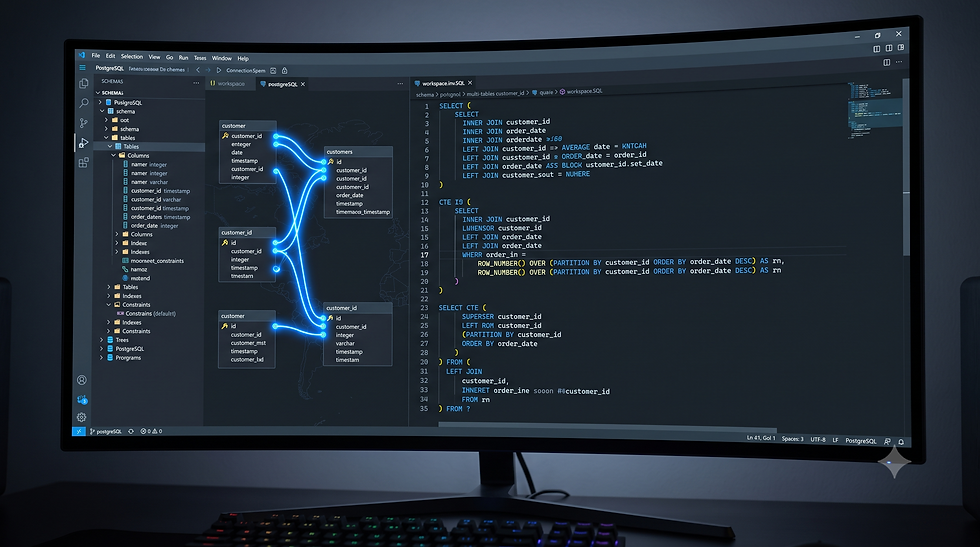
1. Production-Grade SQL & Relational Architecture
Enterprise data does not live in tidy, ready-to-use CSV files on a desktop; it resides in complex relational databases like PostgreSQL, MySQL, and Snowflake. SQL remains the universal engine feeding every dashboard, statistical workflow, and AI pipeline.
Companies do not pay for elementary SELECT * commands. They pay for candidates who can execute:
Multi-Table Relational Logic: Managing intricate INNER, LEFT, and self-joins across millions of rows without creating Cartesian duplicates that distort revenue numbers. For a foundational look into join mechanics, review our detailed guide: Understanding SQL Joins: A Comprehensive Guide.
Analytical Window Functions: Implementing performant calculations using ROW_NUMBER(), DENSE_RANK(), LEAD(), and LAG() to analyze rolling transaction periods and cohort trends.
Query Optimization: Structuring Common Table Expressions (CTEs) and indexing logic so queries complete in seconds rather than locking up production tables.

2. Scalable Data Wrangling & Automated Pipelines (Python)
Once raw database tables are extracted, data arrives corrupted: timestamps carry mixed timezones, customer IDs duplicate, and columns contain invalid characters. Software operators try to fix this manually by clicking through spreadsheets, which wastes dozens of work hours.
Companies pay top salaries to analysts who write repeatable Python scripts using Pandas and NumPy to ingest, clean, validate, and summarize thousands of dirty rows automatically. If you are wondering how early to transition from basic spreadsheets into programmatic scripting, read our practical evaluation: Python vs. Excel: Which Should Beginners Learn First for Data Jobs?.

3. Business KPI Framing & Decision Delivery (Power BI / Tableau)
An algorithm or database calculation produces zero commercial value if non-technical company leadership cannot interpret it. Recruiters pay for analysts who translate math into strategic decisions:
True Metric Engineering: Separating vanity metrics (clicks, page impressions) from bottom-line levers (Customer Acquisition Cost, Lifetime Value, Churn Rate).
Interactive Dashboard Architecture: Structuring responsive reports with drill-down filters and custom DAX measures in Power BI so executives can pinpoint operational losses in minutes.
Scripted Visualization: Connecting Python scripts directly into Power BI to unlock advanced visual aggregations. Learn how to bridge both environments in our tutorial: Using Python in Power BI for Data Analytics.
Part 2: The Data Skills You Should Safely Ignore as a Beginner
Fresher roadmaps frequently get derailed by studying tools that have low industry demand for junior roles or provide minimal return on effort:
Tool / Concept to Ignore | Why You Should Skip It Initially | What to Focus on Instead |
R Programming | Largely restricted to niche academic and clinical research; commercial industry runs predominantly on Python. | Python (Pandas, NumPy). |
Hadoop & Distributed Big Data | Modern cloud warehouses (Snowflake, BigQuery) manage clustering automatically; junior analysts rarely configure clusters. | Advanced SQL & CTE query optimization. |
Deep Learning for Tabular Data | Neural networks are over-engineered for structured business rows; gradient-boosted trees consistently outperform them. | Decision Trees, Random Forests, XGBoost. |
Kaggle Benchmark Datasets | Submitting Titanic or Iris datasets flags your profile as an unoriginal tutorial copy within seconds. | Raw datasets scraped from public APIs or government portals. |

Part 3: From Theory to High-Demand Skills at IOTA Academy
Avoiding low-yield tools requires structured, mentor-led discipline on production
problems rather than passive video tutorials.
Designed by IIT alumni and enterprise analytics practitioners, IOTA Academy delivers hands-on offline and online training focused entirely on high-demand enterprise skillsets:
Explore Our Core Career Tracks:
Business Analytics with Gen AI (Duration: 4 Months): Master Advanced Excel, SQL, and Power BI integrated with Generative AI tools for rapid business intelligence.
Data Analytics with Gen AI (Duration: 6 Months): Build deep competence in advanced database querying, automated Python data manipulation, and executive reporting.
Data Science with Gen AI (Duration: 8 Months): Develop statistical modeling, machine learning pipelines, and production Generative AI applications.
Machine Learning (Duration: 12 Months) & Artificial Intelligence (Duration: 15 Months): Master mathematical foundations, complex neural architectures, and enterprise AI system deployment.
Modular Upskilling Tracks: Dedicated short-term practical modules covering Python, Power BI, Advanced Excel, and SQL.
Why Practical Mentorship Beats Passive Certifications:
IITian Mentorship: Understand Linear Algebra, Cost Functions, and algorithmic tradeoffs through visual intuition without memorizing textbook jargon.
Real, Uncurated Datasets: Work on messy, incomplete data dumps to build defensible data wrangling skills.
Live Technical Drills: Weekly whiteboard challenges and SQL screening rounds eliminate interview panic before corporate evaluations.
GitHub Portfolio Proof: Graduate with deployed repositories and business dashboards that pass recruiter screens immediately.
👉 Stop memorizing low-value tools and build what gets hired. Explore IOTA Academy Courses & Enquire Now.
data skills companies pay for
most in demand data analytics skills 2026
what skills do data analysts actually need
skills data analysts should ignore
SQL window functions for interviews
Python vs Excel for data analytics
IOTA Academy Indore data analytics course
IITian tech mentorship Indore


Comments